Release Kommentar
Kurtan – The Forgotten Georgian Puzzle Game That Became "Kurt" in Germany
A nearly forgotten DOS puzzle game from Georgia that even received an official German release in the early 1990s. We take a closer look at its history, the rare German version "Kurt", and our new universal loader featuring several quality-of-life improvements.

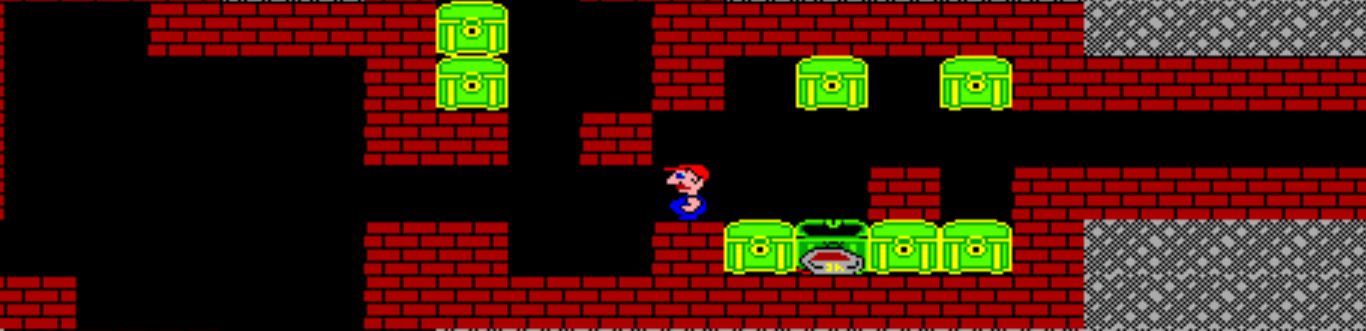
Dear Readers!
Some DOS games are remembered because they became huge commercial successes. Others earned their place in history through famous developers, innovative technology or infamous copy protection schemes.
And then there are games like Kurtan.
An unusual puzzle game from Georgia whose creators have largely been forgotten, whose German release remained almost undocumented for decades, and whose true uniqueness only becomes apparent once you take a closer look.
Kurtan is far more than just another Sokoban clone. It combines classic crate-pushing gameplay with health management, keys, locked passages, sprawling labyrinths and a rather unusual movement system.
To make these different versions easier to enjoy today, DOSGAME.AT has created a universal loader supporting multiple Russian releases as well as the rare German edition, Kurt, while adding several much-needed quality-of-life improvements.
A Game from Tbilisi
Kurtan was developed by TbiliSoft. Even the company name strongly suggests that the studio or development team was based in Tbilisi, although very little documentation about the company has survived. No official company history is known today. There is no surviving product catalogue, and even the names of the programmers, artists and designers remain unknown.
One thing is clear: Kurtan appears to be the only game ever released by TbiliSoft that is known today.
The original Russian version most likely appeared in 1990, during an extraordinary period of political and economic change. Georgia was still part of the Soviet Union, while Perestroika was opening the door for private software companies and international business partnerships.
Kurtan is therefore more than just another DOS game. It is also a small piece of computing history—a Georgian PC title that eventually found its way into the German retail market.
Some modern databases describe TbiliSoft as a Georgian-American joint venture. However, no contemporary documentation supporting this claim has ever surfaced, making the statement impossible to verify.
More Than Just Sokoban
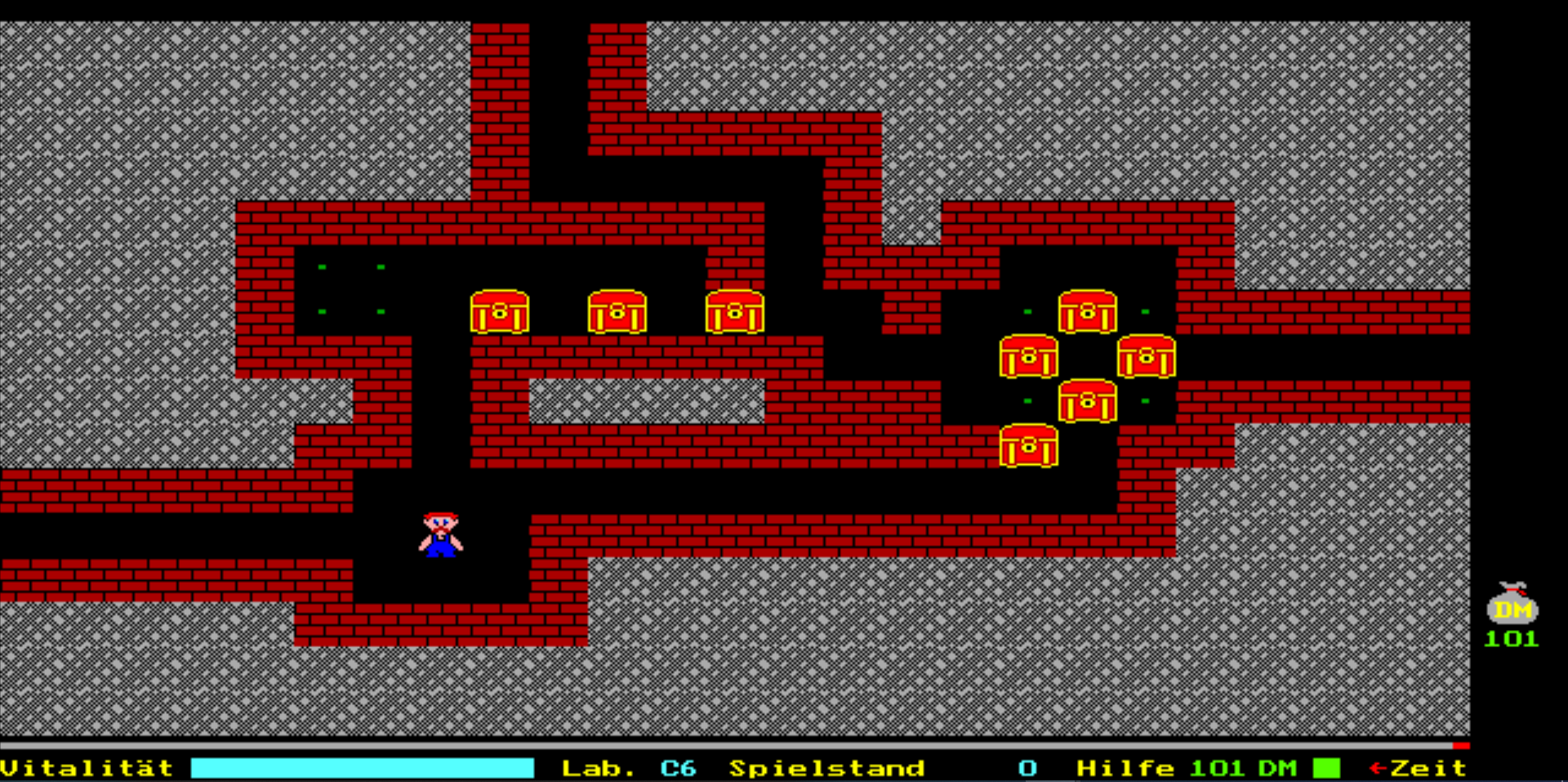
At first glance, Kurtan looks very much like Sokoban. Players guide a worker through maze-like environments while pushing heavy crates and chests into their proper positions. One careless move can permanently block a puzzle.
But Kurtan expands that concept considerably. Instead of isolated puzzle screens, the game features 36 interconnected labyrinths, complete with keys, locked doors, ladders, food, an in-game hint system and a health mechanic. Every movement and every physical action drains energy.
Players therefore have to think about far more than crate placement. Resource management becomes just as important as puzzle solving.
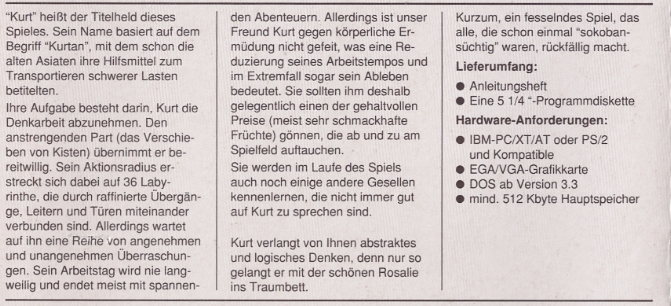
The German packaging humorously describes this relationship by explaining that the player does all the thinking while Kurt performs the physical work. Unfortunately for Kurt, too much work eventually exhausts him—and can even kill him. Unlike traditional Sokoban, Kurtan features an actual protagonist, resource management and even a simple narrative.
The German manual also introduces a character named Rosalie, whom Kurt hopes to reach. Only players capable of careful planning and logical thinking are likely to succeed.
What Does "Kurtan" Mean?
The title is probably not a made-up fantasy word.
Historical Georgian and Russian sources associate the word куртан (kurtan) with traditional porters. Depending on the source, it may refer to the carrying harness, the porter together with his equipment, or even the complete carrying apparatus. Unfortunately, no definitive dictionary definition covering all historical uses has been found.
The title therefore most likely refers not to the protagonist himself, but to the tools and profession associated with carrying heavy loads—a fitting choice considering the game's central mechanic.
The German packaging offers its own explanation, claiming that "the ancient Asians" used the word Kurtan for devices employed to transport heavy objects. While the basic idea appears plausible, this description was almost certainly written as marketing copy rather than as an academically precise linguistic explanation.
For the German market, Kurtan simply became Kurt.
The protagonist received a familiar German name, although much of the original meaning behind the title was inevitably lost.
The German Release: "Kurt"
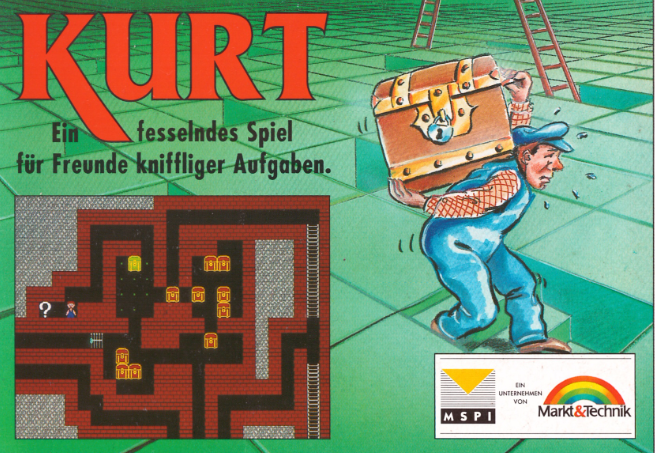
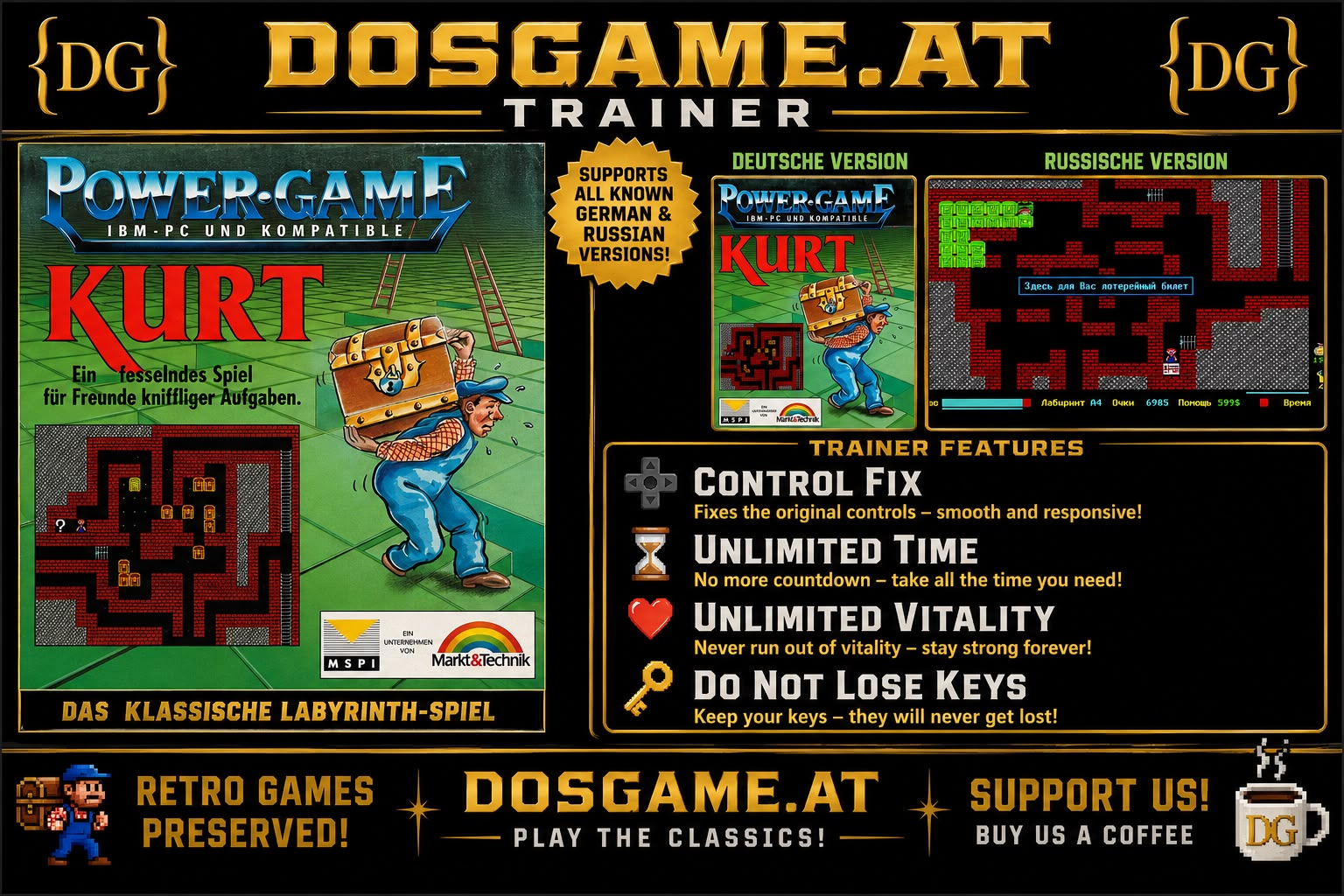
The German version is neither a fan translation nor a later community project. It was an official commercial release complete with professionally printed packaging, a German manual and a fully localized executable. Released in 1991 under the title:
Kurt – A Fascinating Game for Lovers of Challenging Puzzles
the game became part of the Power-Game software series for IBM PCs and compatibles.
Both the packaging and floppy disk identify the publisher as:
M&T Software Partner International GmbH (MSPI)
MSPI belonged to the Markt & Technik group and was responsible for software production, marketing and distribution.
The game shipped on a single 360 KB floppy disk carrying product number 38025.
Recommended retail prices were:
- DM 59
- CHF 54
- ATS 510
indicating that the release was intended not only for Germany, but also for Austria and Switzerland.
Minimum system requirements were modest:
- IBM PC/XT/AT or compatible
- EGA or VGA graphics
- DOS 3.3 or later
- 512 KB RAM
Unlike many large boxed PC games of the era, Kurt was sold in compact retail packaging, most likely through computer stores, bookstores and department stores supplied by Markt & Technik.
How many copies were actually produced remains unknown, and complete originals have become extremely rare today.
Who Translated the Game?
The identity of the translator remains unknown.
The localization was most likely carried out by MSPI or Markt & Technik, although freelance translators may also have been involved.
The adaptation went well beyond a literal translation. The title was changed, the protagonist was renamed "Kurt", and the connection between "Kurt" and the original word "Kurtan" was specifically explained for German customers.
The packaging itself also feels like a complete editorial rewrite rather than a direct translation of Russian promotional material.
Modern databases additionally list Intercomputer as a publisher. Exactly what role the company played remains unclear. It may have been involved in licensing or international distribution, but no contemporary documentation confirming this has surfaced.
Three Different Versions
Today, at least three DOS versions are known:
- Kurtan v1.1 (Russian)
- Kurtan v2.01 (Russian)
- Kurt v2.01 (German)
The executables differ significantly in size:
- Russian v1.1: 84,640 bytes
- Russian v2.01: 167,830 bytes
- German v2.01: 104,780 bytes
This clearly demonstrates that the German release is far more than a simple language replacement. Despite these differences, all versions are based on the same underlying game logic.
The Biggest Problem: The Controls
Kurtan features an unusual movement system.
Instead of moving exactly one tile per key press, the character often continues moving for several tiles, making precise navigation surprisingly difficult. The behaviour is somewhat reminiscent of early Sierra adventures.
This was probably manageable on the slower hardware available in 1990. On later PCs and in modern DOS environments, however, the controls quickly become frustrating.
The issue is far from new.
Already during the 1990s, players developed utilities that converted the movement into proper step-by-step controls. Even owners of faster Pentium systems considered the game difficult to control. Much of Kurtan's notorious difficulty therefore comes not from its puzzles, but from a movement system closely tied to the speed of contemporary hardware.
The DOSGAME.AT Loader
Our loader addresses exactly these issues.
It automatically detects the installed version and applies only the appropriate modifications.
Currently supported are:
- Russian version 1.1
- Russian version 2.01
- German version 2.01
The most important feature is:
F1 – Control Fix
The Control Fix changes the movement mode from "Running" to "Walking", allowing Kurt to move one tile at a time while preserving the original gameplay. At this point we'd like to thank Old-Games.ru, whose earlier control fix served as the basis for our own implementation.
Our loader also includes the following optional quality-of-life features:
- Unlimited Vitality
- Never Lose Keys
- Free Hints
- No Time Limit
In our opinion, puzzle games and strict time limits rarely make a good combination. If you prefer a more relaxed experience, you can simply disable the time limit and enjoy solving the puzzles at your own pace.
Our goal was never to change the game itself. Instead, we wanted to preserve the original experience while removing outdated technical frustrations that were never intended to be part of the challenge.
A Known Bug in Version 2.01
Even version 2.01 isn't completely bug-free.
Players are specifically advised not to collect a certain ghost or question-mark item inside Labyrinth D2, as doing so may make the game impossible to finish.
Whether this is caused by a programming error, an incorrect state change or an unintended dead end still requires further investigation. Sometimes the safest decision is simply not to pick up every item you find.
Why Kurtan Deserves Preservation
Kurtan was never a blockbuster.
That is exactly what makes it so fascinating.
It originated in a region whose early commercial PC gaming history remains largely undocumented in the West. It was officially localized for German-speaking countries before disappearing almost entirely from public awareness.
Its unusual combination of classic Sokoban mechanics, resource management and freely interconnected puzzle areas would probably be described today as an open-world Sokoban. Instead of progressing from one isolated level to the next, players explore an entire world filled with puzzles.
The German version, Kurt, is particularly valuable because it demonstrates that even a small Georgian DOS game could find its way onto store shelves throughout Germany, Austria and Switzerland via Markt & Technik.
Much about the game's history remains unknown:
- the identities of its developers
- the complete history of TbiliSoft
- Intercomputer's role
- the translator of the German version
- production numbers
- actual sales figures
Without preserved floppy disks, packaging, manuals and technical research, small titles like Kurtan would eventually disappear, leaving behind little more than a filename in an abandoned database.
With our universal loader, we hope to ensure that Kurtan is not only preserved, but also remains enjoyable to play on modern systems. After all, preserving forgotten games is exactly why DOSGAME.AT exists.
Enjoy!
- Eric
RELATED RELEASES
Related downloads for this article
DOSGAME.AT // DISCUSSION
Comments and additions
Do you have thoughts, experiences or additional information about this post? Share them with us. Comments are reviewed before publication.
Nice post, thank you!
My father showed me this game about 25 years ago.
Nowadays - I've created webpage of this game, playable in browser.
Also, this version is with patched controls, no need to stop movement.
site address is kurtan . 6rv . org (remove spaces)
Thank you for your response. Yes, it is a really nice game and we think it should be preserved.
The Online Browser Version you have created works very well. Great work!
Best Regards
Eric